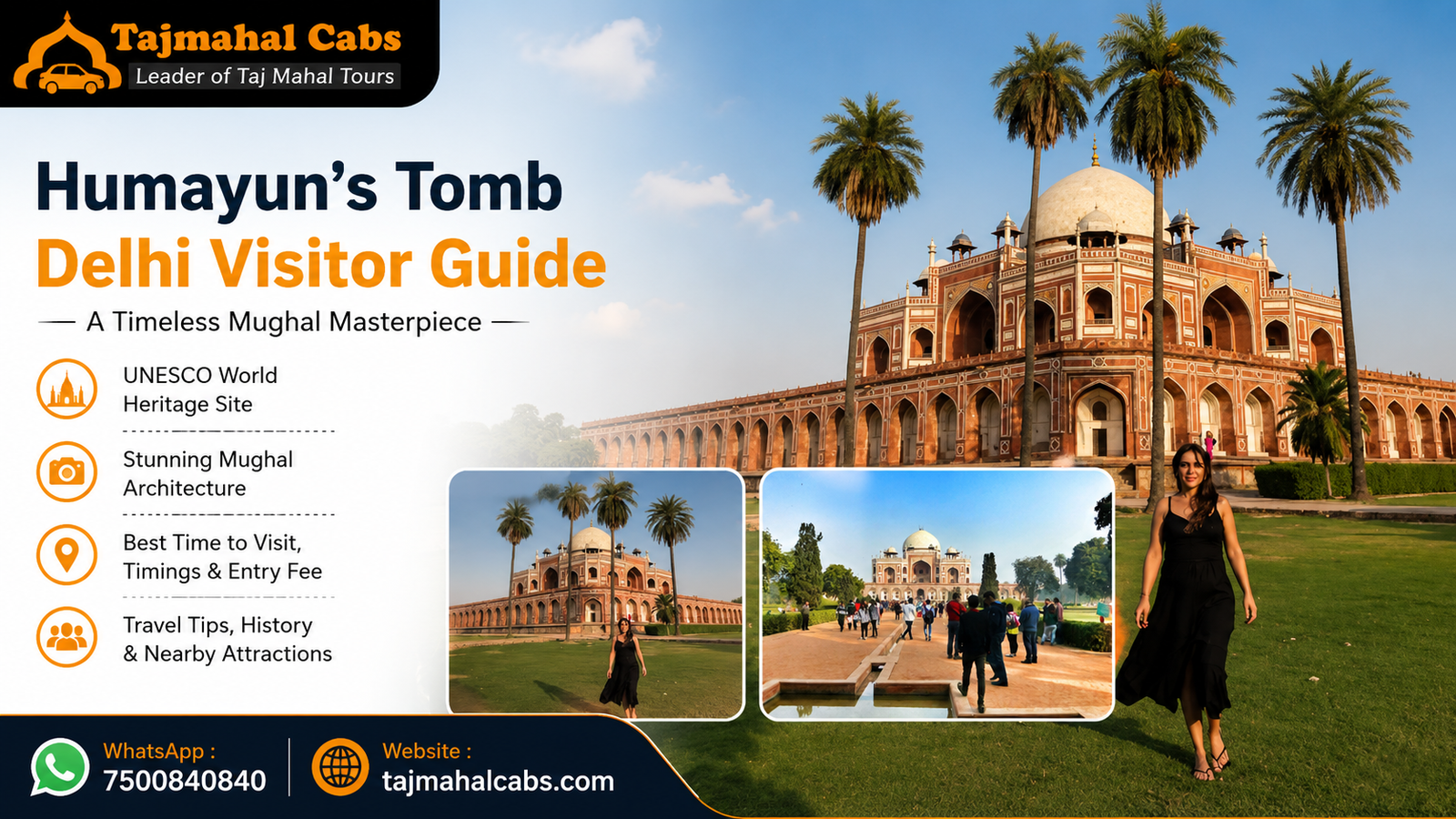
Humayun’s Tomb Delhi: First-Time Visitor Guide
Humayun’s Tomb Delhi: First-Time Visitor Guide
If you are visiting Delhi for the first time, Humayun’s Tomb is one of the most worthwhile heritage sites to include in your itinerary—especially if you are interested in Mughal history, architecture, gardens, and the story that connects Delhi with the Taj Mahal in Agra.
This guide focuses on what a first-time visitor actually needs to know: what Humayun’s Tomb is, why it matters, what you can see, how much time to allow, how to plan your visit, and how it can fit into a Delhi-to-Agra journey.
Humayun’s Tomb was built in 1570 and is a UNESCO World Heritage Site. UNESCO describes it as the first garden-tomb on the Indian subcontinent and notes that its architectural innovations influenced later Mughal architecture, culminating in the Taj Mahal.
What Is Humayun’s Tomb?
Humayun’s Tomb is the mausoleum of Humayun, the second Mughal emperor of India.
The monument was commissioned by his widow, Bega Begum, and built in the 16th century. It stands within a large garden complex containing several other historic structures and tombs.
The main mausoleum is particularly notable for its:
- Red sandstone exterior
- White and black marble details
- Large double dome
- Symmetrical design
- Arched entrances
- Elevated platform
- Charbagh garden
- Water channels and pools
Rather than being simply one isolated tomb, the site is a larger historic landscape containing several Mughal-era monuments. UNESCO identifies structures including Isa Khan’s tomb, Nila Gumbad, Bu Halima, Afsarwala and the Barber’s Tomb within the broader heritage property.
Why Is Humayun’s Tomb Important?
The importance of Humayun’s Tomb goes beyond the fact that it is an attractive monument.
It represents an important stage in the development of Mughal architecture in India.
The monument combines Persian-influenced planning with Indian architectural traditions, particularly in its monumental garden setting, symmetry, dome and use of red sandstone with marble.
UNESCO identifies it as the first garden-tomb on the Indian subcontinent and says its architectural innovations helped lead toward later Mughal masterpieces, culminating in the Taj Mahal.
That makes Humayun’s Tomb particularly interesting for travelers who are also visiting Agra.
Instead of seeing Delhi and Agra as completely separate destinations, you can understand them as part of a longer Mughal architectural story.
Is Humayun’s Tomb the Same as the Taj Mahal?
No.
Humayun’s Tomb and the Taj Mahal are two different monuments, built in different periods for different Mughal rulers.
Humayun’s Tomb is the mausoleum of Emperor Humayun.
The Taj Mahal was built much later by Shah Jahan as the mausoleum of Mumtaz Mahal and eventually Shah Jahan himself.
However, there is an important architectural relationship between them.
Humayun’s Tomb represents an important earlier stage of Mughal garden-tomb architecture, while the Taj Mahal represents a later and more elaborate development of Mughal architecture. UNESCO specifically describes the architectural development associated with Humayun’s Tomb as culminating in the Taj Mahal.
If you want to compare the two monuments directly, see the detailed Taj Mahal vs Humayun’s Tomb comparison.
Is Humayun’s Tomb Worth Visiting?
For many first-time visitors to Delhi, yes.
It is particularly worthwhile if you enjoy:
- Mughal architecture
- Historic monuments
- Photography
- Gardens
- Indian history
- Quiet heritage sites
- Architectural details
It is also a good choice if you want to understand more about the architectural background behind monuments you will later see in Agra.
However, if you have only a very short time in Delhi, you may need to prioritize.
The right question is not simply:
“Is Humayun’s Tomb famous?”
Instead ask:
“Does it fit what I want to experience in Delhi?”
For travelers interested in Mughal history and architecture, it usually does.
Where Is Humayun’s Tomb?
Humayun’s Tomb is in New Delhi, in the Nizamuddin area.
Its location makes it practical to combine with other attractions in central and southern Delhi, depending on your route and available time.
Delhi is a large city, so do not assume that two attractions that look close together on a map will necessarily take only a few minutes to reach.
Traffic can significantly affect journey times.
For a first-time visitor, it is better to group attractions geographically rather than repeatedly crossing the city.
How Much Time Do You Need at Humayun’s Tomb?
Allow approximately 1.5 to 2 hours if you want to explore the main tomb, gardens and surrounding monuments without rushing.
You could spend less time if you only want to photograph the main mausoleum.
You may want longer if you enjoy architecture or want to explore the wider complex carefully.
A practical first-time visit might look like:
Main entrance → garden → Humayun’s Tomb → surrounding structures → photographs → exit
If you are combining the monument with several other Delhi attractions, around 1.5 hours can be a useful planning estimate, but avoid scheduling your day so tightly that a small delay ruins the rest of your itinerary.
What Can You See at Humayun’s Tomb?
The main mausoleum is obviously the centerpiece, but there is more to see than the famous red-and-white structure.
The Main Mausoleum
The central tomb stands on a large raised platform.
Its monumental scale, symmetry, double dome and combination of red sandstone and marble make it one of Delhi’s most distinctive Mughal monuments.
The Charbagh Garden
The tomb is surrounded by a traditional charbagh, or four-part garden.
The garden layout is an important part of the architectural experience rather than simply decoration.
Water channels and geometric pathways contribute to the overall symmetry of the complex. UNESCO identifies the charbagh garden as one of the site’s significant architectural features.
Isa Khan’s Tomb
Isa Khan’s Tomb is another important monument within the heritage area.
It predates Humayun’s Tomb and gives visitors a useful glimpse into earlier architectural traditions in the area.
If you have enough time, don’t rush directly to the main mausoleum and leave.
Exploring the surrounding structures helps you understand why the site is considered a broader historic complex.
Other Historic Structures
The heritage property also includes structures such as Nila Gumbad, Bu Halima, Afsarwala and the Barber’s Tomb.
This is one reason I recommend allowing more than just 30 minutes for the visit.
What Makes the Architecture Interesting?
Look beyond the overall photograph.
First-time visitors often notice the huge dome and red sandstone first, but several smaller details are worth looking at.
Pay attention to:
- Symmetry
- Arched entrances
- Marble borders
- Geometric patterns
- The raised platform
- Garden alignment
- Water channels
- Small domed kiosks
- Repeated architectural forms
The monument’s design creates a strong relationship between the central building and the surrounding garden.
This is one of the reasons the site is useful for understanding Mughal architectural development.
Humayun’s Tomb and Mughal Architecture
One of the best ways to appreciate the monument is to think of it as part of an architectural timeline.
You can look at the development broadly as:
Earlier Islamic and Persian-influenced traditions
↓
Mughal garden-tomb architecture
↓
Humayun’s Tomb
↓
Later Mughal architectural development
↓
Taj Mahal
This does not mean that the Taj Mahal is simply a copy of Humayun’s Tomb.
The buildings are different in scale, purpose, design and historical context.
But Humayun’s Tomb is an important part of the architectural development that eventually produced the Taj Mahal. UNESCO explicitly identifies this progression.
When Is the Best Time to Visit Humayun’s Tomb?
For most visitors, morning or late afternoon can be comfortable choices, particularly when temperatures are high.
Morning has another advantage for travelers who want to continue sightseeing afterward.
Late afternoon can provide attractive light for photography, but you should allow enough time to explore before the site closes.
Because opening hours and visitor arrangements can change, check the current official information before travelling rather than relying on an old travel article.
Delhi Tourism lists Humayun’s Tomb among the city’s major visitor attractions and maintains official tourism information for Delhi.
How Long Should You Spend in Delhi Before Going to Agra?
This depends on your overall India itinerary.
If Delhi is your arrival city, you do not necessarily need to see every major monument before travelling to Agra.
For first-time visitors with limited time, a better approach can be to choose a few meaningful Delhi attractions and then continue toward Agra.
For example:
Morning
Humayun’s Tomb
Late morning
Other nearby Delhi sightseeing
Afternoon
Continue with your Delhi itinerary
Later
Travel onward to Agra, depending on your schedule
If you have more time, an overnight stay in Delhi may make more sense.
If you have very limited time, you can instead arrange your Delhi and Agra sightseeing around your flight and hotel locations.
Can You Visit Humayun’s Tomb Before the Taj Mahal?
Yes, and this can actually make sense for travelers interested in Mughal architecture.
A Delhi-to-Agra itinerary can provide a natural historical progression:
Delhi → Humayun’s Tomb → Agra → Taj Mahal
You first see an important earlier Mughal garden-tomb and later experience the Taj Mahal in Agra.
This doesn’t mean you have to visit Humayun’s Tomb before the Taj Mahal.
But for travelers interested in architecture, seeing both can make the differences between earlier and later Mughal design more meaningful.
If you’re planning to travel directly from Delhi toward Agra, our Delhi to Agra travel guide explains the main transportation options, including road and rail travel.
Can You Visit Humayun’s Tomb and the Taj Mahal in One Day?
Technically, you could combine Delhi sightseeing with a Delhi-to-Agra journey, but I would be cautious about trying to pack too much into one day.
Humayun’s Tomb is in Delhi.
The Taj Mahal is in Agra, roughly 230 km away by road from Delhi.
That means you need to account for:
- Delhi traffic
- Travel time
- Monument opening hours
- Security checks
- Time inside each site
- Meals
- Rest stops
- Return or hotel arrangements
If your main goal is the Taj Mahal, don’t sacrifice your Taj Mahal visit simply to add another Delhi monument.
For a first-time visitor, the Taj Mahal should normally remain the priority if you have limited time.
Humayun’s Tomb as Part of a Golden Triangle Trip
If you are planning the classic Delhi–Agra–Jaipur Golden Triangle, Humayun’s Tomb can fit naturally into the Delhi portion.
The broader journey can look like:
Delhi
Humayun’s Tomb and other Delhi attractions
↓
Agra
Taj Mahal and Agra Fort
↓
Jaipur
Forts, palaces and historic city
This gives you a much broader introduction to North Indian history and architecture than visiting the Taj Mahal in isolation.
For travelers planning a longer journey, you can explore the site’s Golden Triangle tour options.
What Should First-Time Visitors Know?
If you have never visited India before, there are a few practical things worth remembering.
1. Leave Extra Time for Delhi Traffic
Google Maps may show a short distance, but traffic conditions can change throughout the day.
Do not schedule attractions with only a few minutes between them.
2. Dress Comfortably
You will be walking outdoors and through large open areas.
Comfortable footwear is more important than dressing for photographs alone.
3. Carry Water
Delhi can become very hot, particularly during the warmer months.
Stay hydrated and plan breaks when necessary.
4. Travel Light
A small bag is easier to manage than carrying unnecessary luggage around a heritage complex.
Always check the current security restrictions before visiting.
5. Don’t Rush the Architecture
The main mausoleum is impressive from a distance, but some of the most interesting details become visible only when you walk around the building.
6. Don’t Treat It as “Just Another Tomb”
The significance of the site comes from its place in the development of Mughal architecture.
Understanding that context makes the visit much more rewarding.
Is Humayun’s Tomb Good for Photography?
Yes.
The monument’s symmetry, garden layout, arches and contrasting sandstone and marble make it particularly photogenic.
Good opportunities include:
- Long views through the garden
- Front-facing symmetrical compositions
- Close architectural details
- Dome photographs
- Garden pathways
- Arches and doorways
- Wider views showing the monument and garden together
Morning and late afternoon can provide different lighting conditions.
However, always follow the site’s current photography and visitor rules.
Humayun’s Tomb vs Taj Mahal: Which Should You Visit?
If you have time for both, visit both.
They provide different experiences.
Humayun’s Tomb
Best for:
- Mughal architectural history
- Garden-tomb design
- Delhi heritage
- Exploring a larger historic complex
- Understanding earlier Mughal architecture
Taj Mahal
Best for:
- Iconic architecture
- Shah Jahan and Mumtaz Mahal’s story
- Monumental marble work
- Agra sightseeing
- The signature Taj Mahal experience
If you have only enough time for one, your decision depends on your itinerary.
For a first-time India visitor with limited time, the Taj Mahal is usually the higher priority.
But if you have a full Delhi sightseeing day, Humayun’s Tomb is an excellent addition.
For a detailed side-by-side discussion, read our comparison of Humayun’s Tomb and the Taj Mahal.
How to Include Humayun’s Tomb in a First-Time India Itinerary
Here are three practical approaches.
Option 1: Delhi Heritage Day
Best for travelers staying in Delhi.
Morning
Humayun’s Tomb
Late morning/afternoon
Other Delhi attractions
Evening
Return to your Delhi hotel
This is the most relaxed option.
Option 2: Delhi → Agra
Best for travelers continuing to Agra.
Morning
Visit Humayun’s Tomb
Later
Continue Delhi sightseeing
Afternoon/evening
Travel toward Agra
Night
Stay in Agra
Next morning
Visit the Taj Mahal
This option works particularly well if you want to see the Taj Mahal at sunrise.
Option 3: Golden Triangle
Best for travelers with more time.
Delhi
Humayun’s Tomb and other heritage attractions
↓
Agra
Taj Mahal and Agra Fort
↓
Jaipur
Rajasthan’s forts, palaces and historic streets
This is where the monument becomes part of a much larger India travel story.
Should You Hire a Car or Taxi for Delhi Sightseeing?
For first-time international visitors, a private car can make a multi-stop Delhi itinerary easier because you don’t have to repeatedly arrange transportation between attractions.
It can be particularly useful for families, couples and travelers carrying luggage.
However, you do not need a private car simply because you are visiting Humayun’s Tomb.
Choose transportation according to your itinerary, budget and comfort.
If your day involves Delhi sightseeing followed by a journey toward Agra, a private vehicle can be more convenient because you can avoid changing transport between major parts of the trip.
Taj Mahal Cabs also offers Delhi–Agra transportation and tour options for travelers who want to combine the two cities.
A Practical First-Time Visitor Plan
If I were helping a first-time visitor build a simple Delhi-to-Agra itinerary, I would avoid trying to see every monument.
A more realistic approach would be:
Day 1 – Delhi
Choose a small number of major attractions, including Humayun’s Tomb if Mughal architecture interests you.
Day 2 – Agra
Visit the Taj Mahal and Agra Fort.
Day 3 – Continue
Return to Delhi or continue toward Jaipur, depending on your Golden Triangle itinerary.
This gives you enough time to actually experience the monuments rather than spending the entire trip sitting in traffic.
Frequently Asked Questions
Is Humayun’s Tomb worth visiting? +
Yes, particularly for visitors interested in Mughal history, architecture and gardens. It is also a UNESCO World Heritage Site.
How old is Humayun’s Tomb? +
The tomb was built in the 16th century and is generally dated to around 1570. UNESCO identifies 1570 as the construction date.
Who built Humayun’s Tomb? +
The tomb was commissioned by Humayun’s widow, Bega Begum, and constructed with the involvement of Persian and Indian craftsmen.
Is Humayun’s Tomb a UNESCO World Heritage Site? +
Yes. Humayun’s Tomb was inscribed on the UNESCO World Heritage List in 1993.
Is Humayun’s Tomb related to the Taj Mahal? +
Architecturally, yes. Humayun’s Tomb is an important earlier example of Mughal garden-tomb architecture, and UNESCO identifies architectural developments associated with it as culminating in the Taj Mahal.
Is Humayun’s Tomb older than the Taj Mahal? +
Yes. Humayun’s Tomb was built in the 16th century, while the Taj Mahal was constructed later under Shah Jahan.
How long should I spend at Humayun’s Tomb? +
For most first-time visitors, around 1.5 to 2 hours is a reasonable planning allowance if you want to see the main tomb, garden and surrounding structures without rushing.
Can I visit Humayun’s Tomb and the Taj Mahal on the same day? +
It is possible in a tightly planned itinerary, but I would not recommend it for most first-time visitors. The two monuments are in different cities, and Delhi traffic and travel time can make the day tiring.
Can I visit Humayun’s Tomb before going to Agra? +
Yes. It can be a particularly good choice for travelers interested in seeing the development of Mughal architecture from Delhi to Agra.
What is the best time to visit Humayun’s Tomb? +
Morning or late afternoon can be comfortable choices, but check current opening information before travelling.
Is Humayun’s Tomb good for families? +
Yes. Families interested in history and architecture can enjoy the gardens and open spaces, although you should allow enough time for walking and rest.
Is Humayun’s Tomb good for photography? +
Yes. The monument’s symmetry, gardens, arches and sandstone-and-marble architecture provide many photographic opportunities.
Final Verdict
Humayun’s Tomb is worth adding to a Delhi itinerary if you want more than a checklist of famous attractions.
It gives first-time visitors an opportunity to understand an important chapter of Mughal architecture before continuing to Agra and seeing the Taj Mahal.
The most useful way to think about the monument is not:
“Is this another famous Delhi tomb?”
Instead:
“What can this monument teach me about the architecture and history I will encounter later in Agra?”
That makes the Delhi-to-Agra journey more meaningful.
If you have enough time, consider:
Delhi heritage → Humayun’s Tomb → Agra → Taj Mahal → Agra Fort
And if you are planning to travel between the two cities, use a practical Delhi-to-Agra travel guide to compare transportation options before deciding how to structure your day.
For travelers planning a private Delhi-to-Agra experience, Taj Mahal Cabs can also help arrange transportation and sightseeing. The important thing is to build the itinerary around your available time rather than trying to fit every attraction into one exhausting day.
👨💼for Booking & Inquiry Please Call / WhatsApp to +91 7500-840-840





Last reviewed: August 2026
Author
Babloo, Taj Mahal Cabs