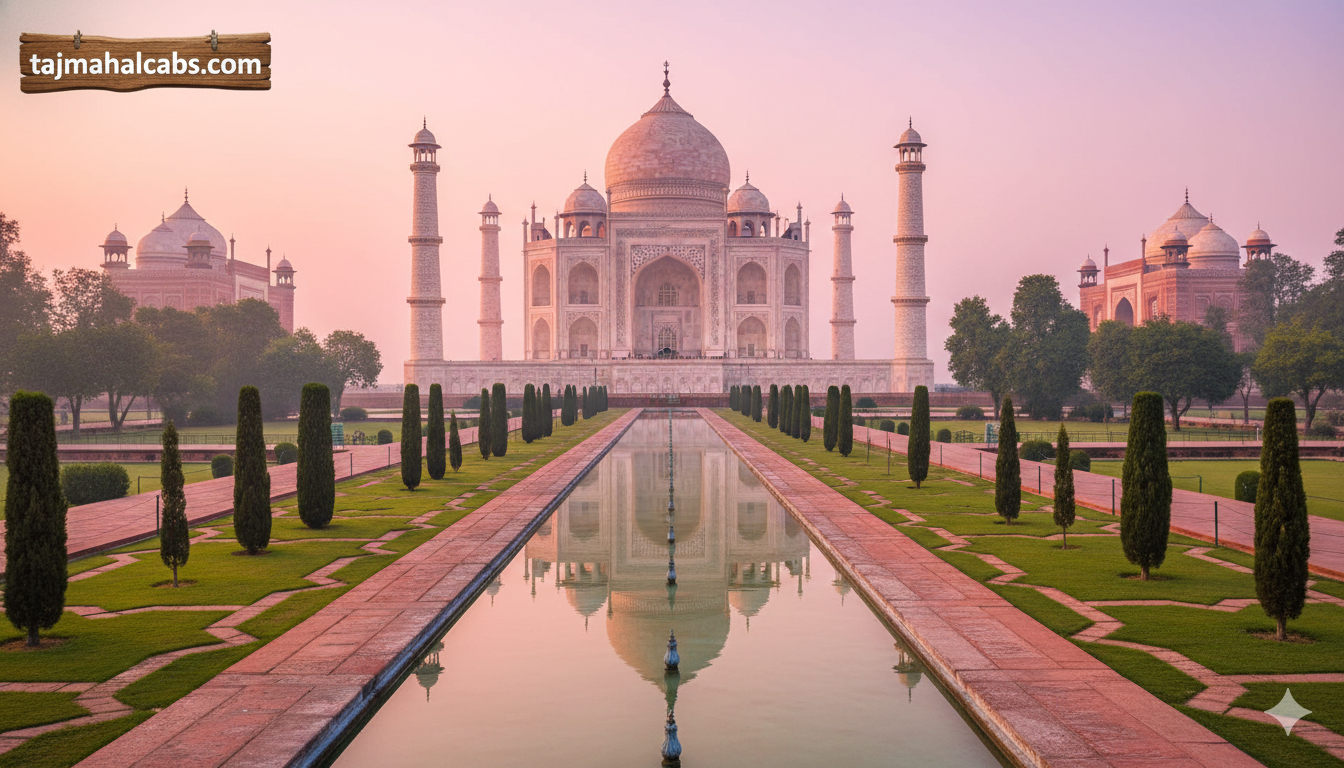
Why Does the Taj Mahal Look Pink at Sunrise?
Why Does the Taj Mahal Look Pink at Sunrise? A Visitor’s Guide
The Taj Mahal is famous for its white marble, but early-morning visitors sometimes notice something unexpected: the monument can appear soft pink, peach, warm ivory or golden as the first sunlight reaches its surface.
This is why people often say that the Taj Mahal “turns pink” at sunrise.
The marble itself does not suddenly change from white to pink. Instead, the changing morning light affects how the white marble looks. The position of the sun, atmospheric conditions, clouds, haze and your viewing position can all influence the colors you see.
For first-time visitors to Agra, understanding this difference is useful because you should not arrive expecting a guaranteed bright-pink Taj Mahal every morning.
The sunrise experience is about watching the monument’s appearance change naturally as daylight develops.
Does the Taj Mahal Really Turn Pink?
Not literally.
The Taj Mahal remains a white-marble monument. The pink appearance is a visual effect created by the interaction between natural light and the marble.
At sunrise, the sun is low on the horizon. The light reaching the monument can have warmer red, orange and pink tones. When that light falls on the white marble, the surface reflects the changing light, making the Taj Mahal appear warmer than it does under stronger daylight.
Depending on the morning, the color may look:
- Pale pink
- Blush
- Peach
- Cream
- Warm white
- Golden
Sometimes the difference is quite subtle.
So “the Taj Mahal turns pink” is a useful description of what visitors may see, but it should not be understood as the marble physically changing color.
Why Does White Marble Look Pink at Sunrise?
The simplest explanation is changing natural light.
White surfaces reflect much of the visible light that reaches them. At sunrise, the light has a different quality and direction compared with the stronger daylight later in the morning.
The surrounding sky and atmospheric conditions also influence the appearance.
This means the Taj Mahal can look different from one morning to another.
You may see a soft pink tone one morning and mostly warm white on another.
The important factors include:
Sun angle:
Early sunlight reaches the monument from a low angle.
Sky conditions:
Clouds can soften or change the appearance of the morning light.
Haze and atmospheric conditions:
Haze can reduce contrast or make the colors appear softer.
Viewing position:
The direction from which you see the monument changes how the light falls across its surfaces.
Camera settings:
Your phone or camera may record the colors differently from what your eyes see.
This is why there is no reliable formula for predicting exactly how pink the Taj Mahal will look.
Does the Taj Mahal Look Pink Every Morning?
No.
This is one of the most important things to understand before planning a sunrise visit.
Travel articles and social-media photographs can make the pink effect look much more dramatic and predictable than it actually is.
On some mornings, the marble may have a noticeable warm or pinkish tone.
On others, it may simply look white with a warmer glow.
Clouds, haze, fog and other atmospheric conditions can change the appearance considerably.
If you are visiting specifically for sunrise photography, plan for changing light rather than one guaranteed color.
That way, you are less likely to be disappointed if the morning looks different from photographs you have seen online.
Why Does the Taj Mahal Change Color During the Day?
The Taj Mahal can appear different as the sun moves across the sky.
Early morning
The marble may appear soft, warm or slightly pink.
Later morning
As daylight becomes stronger, the monument can look much brighter and whiter.
Afternoon
The stronger light creates sharper contrast and a brighter appearance.
Evening
Warm late-day light can give the marble a cream or golden appearance.
The monument itself isn’t changing its marble color.
The illumination is changing.
That is one of the interesting things about photographing white marble architecture.
Is Sunrise a Good Time to Visit the Taj Mahal?
For many visitors, yes.
But sunrise isn’t automatically the best choice for everyone.
A sunrise visit can be particularly appealing if you want:
- Softer morning light
- Changing colors
- Photography opportunities
- A cooler start during warmer periods
- A different atmosphere from the middle of the day
However, you also need to deal with an early start and current visitor arrangements.
Before your trip, check the current opening information and plan your transportation accordingly.
For more practical timing advice, see our Taj Mahal morning visit planning guide.
How Early Should You Arrive?
Don’t use one fixed arrival time for every month.
Sunrise changes throughout the year, and monument entry arrangements can also change.
A better approach is to:
- Check the sunrise time for your travel date.
- Check current Taj Mahal visitor information.
- Confirm your ticket arrangements.
- Allow enough time to reach the entrance.
- Allow time for security procedures.
- Avoid making your schedule so tight that a small delay ruins your morning.
If you’re planning specifically around sunrise, our Taj Mahal sunrise entry guide provides additional practical information.
Which Entry Gate Should Sunrise Visitors Use?
Your best entry point depends on your accommodation, transportation and the current arrangements at the monument.
Don’t assume that one gate is always the “best” for every visitor.
Before traveling, check:
- Which entrance is most convenient
- Current entry arrangements
- Walking distance
- Security procedures
- Your transportation drop-off point
Our guide to Taj Mahal entry gates for sunrise visitors can help you understand the options before you leave your hotel.
What Is the Best Place to See the Pink Effect?
For most visitors, the classic view is from the main garden looking toward the Taj Mahal.
This gives you the familiar combination of:
- White marble
- Reflecting pool
- Charbagh gardens
- Cypress trees
- Main gateway
- Symmetrical architecture
The changing morning light can make this familiar view look very different from photographs taken later in the day.
Rather than moving around constantly to find a “perfect” spot, spend some time watching how the light changes.
What About Views From the Yamuna Side?
The Yamuna side can provide a different perspective of the Taj Mahal and may appeal to photographers looking for alternative compositions.
However, visitors should distinguish between official monument access and external viewpoints.
Don’t assume that a location you see in a photograph is part of the normal Taj Mahal visitor route or that the same access rules apply there.
If photography is your main interest, our Taj Mahal photography and photoshoot guide can help you think about your photography plans.
Sunrise Photography: What Should You Know?
You don’t need expensive equipment to photograph the Taj Mahal at sunrise.
A smartphone can produce excellent travel photographs when the light is good.
Smartphone tips
Try:
- Keeping your phone steady
- Tapping the monument to adjust exposure
- Taking several photographs as the light changes
- Avoiding excessive filters
- Including the garden or reflecting pool in some compositions
Camera tips
If you’re using a dedicated camera, experiment with:
- Exposure
- White balance
- Different focal lengths
- Architectural details
- Wider compositions
Don’t try to force the pink color through heavy editing.
The natural changes in the light are usually more interesting.
Check the Taj Mahal Photography Rules Before You Go
This is especially important if you’re carrying photography equipment.
Do not assume that equipment allowed at other tourist attractions will automatically be permitted inside the Taj Mahal complex.
For current practical guidance, read our Taj Mahal photography rules and visitor guidance before your visit.
The rules and operational arrangements can change, so current information should always take priority over older travel articles.
Can You Use a Tripod?
Don’t plan your Taj Mahal visit around bringing a tripod unless you have confirmed that it is permitted under the current rules.
Your existing Taj Mahal Cabs photography guidance states that tripods are not permitted within the monument complex.
So the safer advice for visitors is:
Check the current photography rules before bringing specialist equipment.
For most travelers, a handheld camera or smartphone is sufficient for sunrise photography.
Is Winter the Best Time to See the Pink Taj Mahal?
You may read that October through March is the “best” period for the pink effect.
I would avoid presenting that as a guarantee.
Winter mornings can provide attractive light, but fog and haze can also affect visibility.
Other seasons can also produce beautiful sunrise conditions.
Instead of choosing your trip solely because someone promises a pink Taj Mahal, consider:
- Weather
- Sunrise time
- Your overall India itinerary
- Your tolerance for early mornings
- How much time you have in Agra
The pink appearance is a natural lighting effect, not a scheduled seasonal event.
What If the Morning Is Foggy or Cloudy?
Your sunrise visit isn’t necessarily wasted.
Clouds can create softer, more diffused light.
Fog or haze can reduce visibility, but it can also produce a different atmosphere.
You simply may not get the strong pink effect shown in photographs taken under clearer conditions.
The best approach is to treat sunrise as an experience rather than a guaranteed photograph.
Should You Visit at Sunrise Just to See the Pink Color?
I wouldn’t recommend making the pink color your only reason.
A sunrise visit can be worthwhile because you get to experience:
- The changing morning light
- The atmosphere of early morning
- Different photographic conditions
- The monument before the stronger daytime light
- The Taj Mahal gradually becoming brighter
The pink appearance is one part of the experience.
Sunrise vs Daytime at the Taj Mahal
Sunrise
Advantages:
- Softer changing light
- Potential warm or pink tones
- Good photography opportunities
- Different atmosphere
Considerations:
- Very early start
- Weather can affect the view
- Current entry arrangements need checking
Daytime
Advantages:
- Easier schedule
- Stronger visibility
- Convenient for travelers who don’t want an early start
Considerations:
- Stronger sunlight
- Potentially warmer conditions
- Different photographic appearance
There is no single correct choice.
Choose the time that fits your travel style.
What Should First-Time Visitors Bring?
Keep your belongings simple.
Useful items may include:
- Phone or camera
- Valid ticket/entry information
- Identification if required
- Weather-appropriate clothing
- Comfortable walking shoes
- Any essential personal items
Avoid carrying unnecessary items that could make security checks slower.
Before your visit, check the current prohibited-items information.
What Should You Wear for a Sunrise Visit?
Early mornings can feel cool during parts of the year, particularly in winter.
A light jacket or extra layer can be useful.
During warmer periods, lightweight clothing may be more comfortable.
Comfortable shoes are also important because visiting the Taj Mahal involves walking.
For additional visitor guidance, see our Taj Mahal dress code and visitor rules.
Can You Combine Sunrise With Other Agra Attractions?
Yes.
A sunrise visit can fit well into a full day of Agra sightseeing.
A simple plan could be:
Taj Mahal → Breakfast → Agra Fort → Lunch → One additional attraction
Depending on your interests, you might add:
- Itimad-ud-Daulah
- Mehtab Bagh
- Akbar’s Tomb
- Chini ka Rauza
- Fatehpur Sikri
Don’t try to visit everything in one day.
Our Agra attractions guide can help you choose places according to your available time.
Planning a Sunrise Visit From Delhi?
This requires more planning than a normal daytime visit.
You need to consider:
- Your departure time from Delhi
- Road or train travel
- Current Taj Mahal entry arrangements
- Travel time within Agra
- Your return journey
If you’re traveling from Delhi specifically for sunrise, don’t create an itinerary with no margin for delays.
For travelers arriving through Delhi airport, our Delhi Airport to Agra travel guide explains the practical journey options.
If you prefer a private vehicle, you can also review Agra sightseeing by taxi when planning transportation within the city.
A Simple Sunrise Plan for First-Time Visitors
Before the trip
- Check the current Taj Mahal opening information.
- Check sunrise time for your travel date.
- Arrange your ticket.
- Check entry arrangements.
- Review photography and security rules.
- Arrange transportation.
On the morning
1. Leave your hotel with enough time.
2. Reach the appropriate entrance.
3. Complete security procedures.
4. Enter the monument complex.
5. Find a comfortable viewing position.
6. Watch how the light changes.
7. Take photographs without allowing photography to dominate the entire experience.
This is a more realistic approach than trying to arrive at one exact minute to “catch the pink Taj Mahal.”
Babloo’s Practical Advice
If you’re visiting the Taj Mahal at sunrise for the first time, don’t expect a guaranteed bright-pink monument.
Some mornings the marble can look distinctly warm or pinkish. On other mornings, the effect may be much more subtle.
Weather and light make every sunrise a little different.
My advice is to arrive prepared, check the current visitor rules, allow enough time, and enjoy the changing light rather than chasing one particular color.
— Babloo, Taj Mahal Cabs
This is the kind of personal perspective that adds value without making unsupported claims about experience or expertise.
Frequently Asked Questions
Why does the Taj Mahal look pink at sunrise? +
The Taj Mahal can appear pink because warm early sunlight falls on its white marble. Atmospheric conditions, the sky and viewing conditions can also influence the appearance.
Does the Taj Mahal actually change color? +
No. The marble does not physically change from white to pink. Its appearance changes as the natural light changes.
Does the Taj Mahal look pink every morning? +
No. The effect varies according to weather, haze, clouds, sunlight and viewing conditions.
What colors can the Taj Mahal appear at sunrise? +
It can appear warm white, cream, peach, blush or pink depending on the conditions.
Is sunrise the best time to photograph the Taj Mahal? +
Sunrise can provide beautiful changing light, but whether it is the best time depends on your photography goals and the weather.
Can I bring a tripod? +
Check the current monument rules before your visit. Taj Mahal Cabs’ current photography guidance advises that tripods are not permitted inside the monument complex.
Is October to March guaranteed to have a pink Taj Mahal? +
No. Seasonal conditions can influence the light, but there is no guaranteed pink effect.
Can I visit the Taj Mahal at sunrise from Delhi? +
Yes, but you’ll need to plan your transportation carefully because the visit requires an early start.
What if it is foggy? +
Fog or haze can soften or obscure the sunrise colors. You may not see the same pink effect shown in clear-weather photographs.
Final Thoughts
The phrase “Taj Mahal turns pink at sunrise” describes something visitors can genuinely observe, but it should not be interpreted as the marble physically changing color.
The monument’s appearance changes because natural light changes.
At sunrise, the white marble can reflect warmer tones and appear pink, peach, cream or golden. The exact effect depends on the morning’s conditions.
That’s why I recommend visiting for the changing light and overall experience, rather than expecting one guaranteed shade.
If you’re visiting Agra for the first time, prepare your transportation, check the current entry and photography rules, arrive with enough time, and give yourself a chance to simply watch the monument change as the morning develops.
The photograph is a bonus.
The experience is the real reason to go.
👨💼for Booking & Inquiry Please Call / WhatsApp to +91 7500-840-840





Last reviewed: August 2026
Author
Babloo, Taj Mahal Cabs