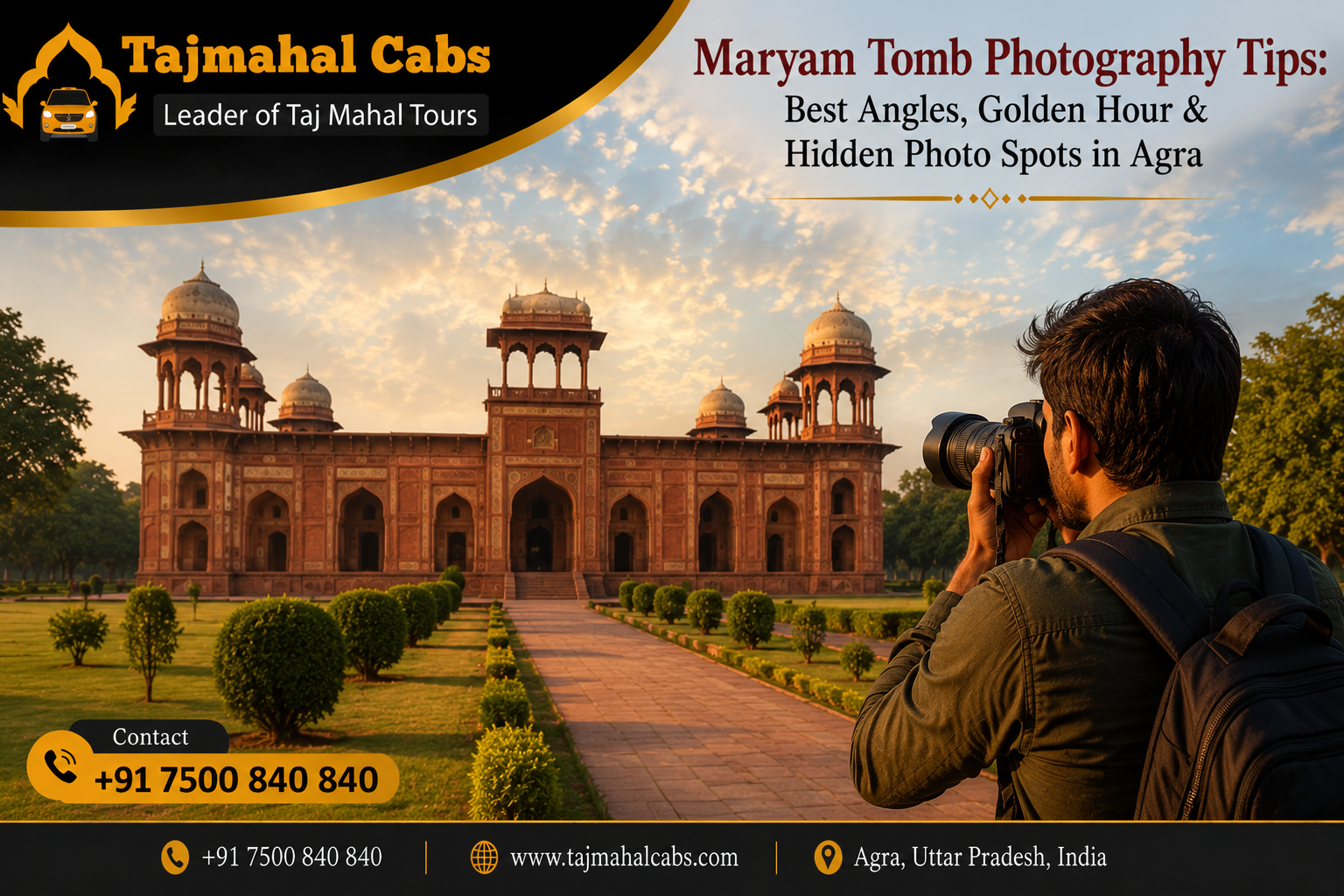
Maryam’s Tomb Photography Tips: What to Photograph
Maryam Tomb Photography Tips: A Practical Guide for Visitors
Maryam’s Tomb in Sikandra is a good place to slow down with a camera. It does not have the scale of the Taj Mahal, but that is part of its appeal. The monument gives you more opportunities to concentrate on stonework, arches, symmetry, textures and smaller architectural details rather than trying to capture one famous view.
You also don’t need professional equipment. A modern phone is enough for most visitors; a camera simply gives you more control over perspective and light.
If you are visiting for the first time, it helps to understand the monument before photographing it. The Maryam’s Tomb Agra travel guide is a useful starting point.
Is Maryam’s Tomb Good for Photography?
Yes, particularly if you enjoy architecture and detail photography.
Instead of looking for one “perfect” photograph, try to photograph the monument in several ways:
- one wide view showing the building in its setting;
- symmetrical views of the main structure;
- close-ups of carved stone and decorative details;
- photographs through arches or openings;
- architectural details from different angles;
- wider photographs that include the surrounding landscape.
The quieter atmosphere can also make it easier to take your time compared with some of Agra’s busier attractions.
For a better understanding of what you’re photographing, see the Maryam’s Tomb architecture guide.
When Is the Best Time to Photograph Maryam’s Tomb?
There isn’t one universal “best” time.
For most architectural photography, early morning and later afternoon are useful because the light is generally softer than around midday.
Early morning
Morning light can help with:
- softer shadows;
- clearer architectural details;
- cooler temperatures;
- a quieter atmosphere.
Late afternoon
Later in the day, changing light can bring more depth to:
- sandstone surfaces;
- arches;
- carved details;
- walls and corners.
The exact light changes throughout the year, so don’t plan around a fixed “golden hour” such as 6:00 AM or 5:00 PM. Check the actual sunrise and sunset for your travel date.
Also check the current Maryam’s Tomb opening hours and entry information before planning an early photography visit.
What Should You Photograph?
A simple shot list can make a short visit much easier.
1. The complete monument
Start with a wide photograph.
Don’t immediately move in for details. First show the building as a whole so the photograph gives some sense of its setting.
2. Symmetry
If the architecture allows it, try a centered composition.
Turn on your phone’s grid lines and check that vertical lines are reasonably straight.
You don’t need a tripod to do this.
3. Arches and openings
Look through an arch rather than photographing the arch itself.
This creates a natural frame and can give a flat architectural photograph more depth.
4. Stone details
Move closer.
Look for:
- carving;
- changes in stone texture;
- decorative patterns;
- corners;
- openings;
- small architectural details.
These photographs often tell more of the building’s story than another wide shot.
5. Different angles
After taking the obvious front-facing photograph, walk around and see how the building changes from the side.
A slight change in position can make the composition much more interesting.
Simple Composition Ideas
You don’t need complicated photography techniques.
Use symmetry
Stand centrally when the architecture naturally calls for it.
Check your vertical lines before pressing the shutter.
Use natural framing
An arch, doorway or architectural opening can act as a frame around another part of the monument.
Include some foreground
A pathway, tree or section of the surrounding landscape can give the photograph more depth.
Try both portrait and landscape orientation
Landscape is useful for showing the setting.
Portrait orientation can work well for taller architectural compositions and social-media posts.
Don’t photograph everything from eye level
Take a few photographs from slightly lower or higher positions if the location allows it.
Even a small change in viewpoint can make the same building look different.
Maryam’s Tomb Photography With a Smartphone
A phone is more than enough for a normal visit.
Before you start
Clean the camera lens.
It sounds obvious, but fingerprints can make photographs look soft or hazy.
Use the grid
Grid lines make it easier to keep architectural lines straight and improve symmetry.
Avoid excessive digital zoom
If you can safely move closer, do that instead.
Digital zoom can reduce detail.
Control exposure
If the sky is very bright, tap the brighter area and adjust the exposure until the highlights look reasonable.
If the monument is in deep shadow, try a slightly brighter exposure—but check that the stone isn’t becoming washed out.
Don’t over-edit
A little adjustment to exposure, contrast or shadows is usually enough.
The stone should still look like stone.
Photographing Architecture in Harsh Midday Light
You may not always have a choice about when you visit.
If you arrive around midday, don’t assume the photography session is ruined.
Instead:
- photograph details rather than only wide views;
- use shaded architectural areas;
- look for stronger shadows;
- try black-and-white compositions;
- avoid pointing directly into harsh sunlight when possible;
- expose carefully for bright stone surfaces.
Sometimes strong shadows can actually add depth to architectural photographs.
Photographing People at Maryam’s Tomb
If you’re travelling with a partner, family or friends, the monument can provide a natural background for travel photographs.
Rather than having everyone stand directly in front of the building, try:
- walking through an open area;
- standing beside an architectural feature;
- looking toward the monument;
- using an arch as a frame;
- leaving some space around the person.
For photographs of strangers, be respectful and ask before taking a close-up portrait.
And never climb, lean on or touch protected architectural elements just to get a photograph.
Couple and Portrait Photography
If you’re travelling as a couple, you don’t need a staged photoshoot to get good photographs.
Natural movement usually works better.
Try:
walking → stopping → looking at the monument → looking away from the camera
Rather than asking someone to hold the same pose for several minutes.
Neutral or earthy clothing can also work well against sandstone, but there is no need to dress specifically for photography.
The important thing is to respect the site and other visitors.
Photography After Rain
If you happen to visit after rain, look for reflections in wet surfaces or puddles.
Don’t create water or move things around just to manufacture a photograph.
Instead, use whatever conditions are already there.
Wet stone and greenery can also produce a different mood from a bright, dry day.
What Camera Gear Do You Actually Need?
For an ordinary visit, very little.
Smartphone
Perfectly adequate for:
- wide views;
- details;
- portraits;
- travel photographs.
Mirrorless or DSLR
Useful if you want more control over:
- focal length;
- exposure;
- depth of field;
- low-light photography.
Wide-angle lens
Useful for photographing the whole structure when you cannot move far enough away.
Standard lens
Good for general travel photographs and details.
Telephoto lens
Useful if you want to isolate architectural details from farther away.
You do not need to buy specialist equipment specifically for Maryam’s Tomb.
Do You Need a Tripod?
Probably not for most visitors.
A tripod can help with:
- low-light photography;
- deliberate long exposures;
- precise symmetrical compositions.
But check the monument’s current photography rules before bringing or setting up one, particularly if you are using larger equipment.
For a normal phone or handheld camera visit, travelling light is easier.
Drone Photography
Don’t assume that because a drone can physically fly over a monument, it is permitted to do so.
Drone use around protected heritage sites can be subject to restrictions, permissions and no-fly requirements.
Check the current rules with the relevant authority before flying.
Do not fly a drone simply because another visitor appears to be doing so.
Photography Etiquette at Maryam’s Tomb
A good photograph isn’t worth disturbing the monument or another visitor.
Keep these simple rules in mind:
- don’t climb on historic structures;
- don’t touch fragile surfaces;
- don’t block entrances or narrow pathways;
- keep equipment out of other visitors’ way;
- avoid loud posing or staged activities that disturb others;
- ask before taking close-up photographs of strangers;
- follow any photography restrictions posted at the site.
The best travel photography leaves the place exactly as you found it.
A 30-Minute Photography Plan
If you have only a short stop, don’t spend the entire visit trying to find the perfect angle.
First 5 minutes
Walk around and look at the monument without taking many photographs.
Next 10 minutes
Take:
- one wide shot;
- one symmetrical composition;
- several architectural details.
Next 10 minutes
Try different viewpoints and natural framing.
Final 5 minutes
Take portraits or a few photographs of the surrounding setting.
This works particularly well if Maryam’s Tomb is one stop in a larger Agra itinerary.
You can see how to combine it with other attractions in the Maryam’s Tomb Agra itinerary.
Photography and the Rest of Your Agra Day
Don’t let photography at one monument make you late for everything else.
If you’re visiting Maryam’s Tomb as part of a larger route, allow enough time for your other planned attractions.
The guide to reaching Maryam’s Tomb can help if you’re arranging the monument as one stop in a wider Agra route.
And if you want to add another nearby heritage stop, see places to visit near Maryam’s Tomb.
A Simple Maryam’s Tomb Photography Checklist
Before leaving, try to capture:
- one complete view of the monument;
- one symmetrical composition;
- one photograph through an arch;
- several architectural details;
- one wider environmental photograph;
- one portrait or travel photograph if appropriate;
- one alternative angle;
- one close-up texture photograph.
That’s enough.
You don’t need 200 photographs of the same doorway.
Maryam’s Tomb Photography: Frequently Asked Questions
Is Maryam’s Tomb good for photography? +
Yes. It is particularly suitable for architectural, detail and travel photography, especially if you enjoy quieter heritage locations.
What is the best time to photograph Maryam’s Tomb? +
Early morning and later afternoon generally provide softer light than midday. The exact conditions depend on the season and weather.
Can I photograph Maryam’s Tomb with a phone? +
Yes. A modern smartphone is sufficient for most visitors.
What should I photograph at Maryam’s Tomb? +
Start with the whole monument, then look for symmetry, arches, stonework, decorative details and different viewpoints.
Do I need a professional camera? +
No. A phone can produce very good travel photographs here.
Can I use a drone? +
Don’t assume it is permitted. Check the current local and monument-specific rules before flying.
How long do I need for photography? +
If photography is only one part of your visit, 30–45 minutes can be enough for a useful collection of photographs. Dedicated photographers may want longer.
A Final Tip
The easiest mistake at a historic monument is to spend the entire visit looking at it through your phone.
Take a few photographs, then put the camera away for a moment.
Look at the stonework, proportions and details with your own eyes. You’ll probably notice something that you would have missed while concentrating on the screen.
If you’re planning a wider Agra day, start with the Maryam’s Tomb travel guide and build the photography stop around the rest of your route.
👨💼for Booking & Inquiry Please Call / WhatsApp to +91 7500-840-840





Last reviewed: August 2026
Author
Babloo, Taj Mahal Cabs