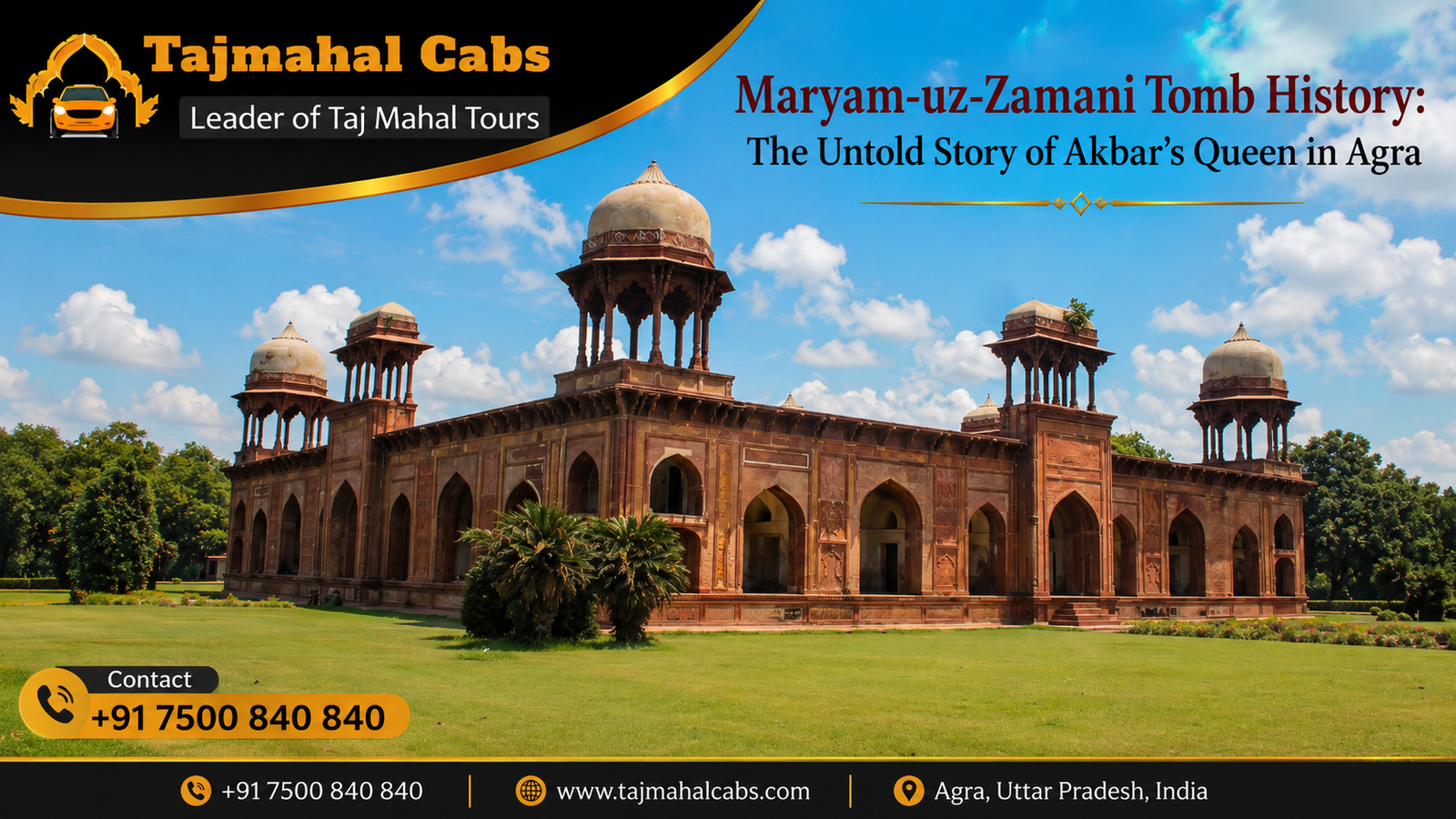
Maryam-uz-Zamani Tomb History: Akbar’s Rajput Queen
Maryam-uz-Zamani Tomb History: The Story of Akbar’s Rajput Queen
The Maryam-uz-Zamani Tomb in Agra is the resting place of Mariam-uz-Zamani, the Rajput empress associated with Emperor Akbar and the mother of Emperor Jahangir. Located near Sikandra, the monument is historically important not only because of the woman buried there, but also because the building itself appears to have been adapted from an earlier Lodi-period structure.
The story is more complicated than the popular descriptions found in many tourist guides. Mariam-uz-Zamani is frequently called “Jodha Bai” in popular culture, but the Archaeological Survey of India’s Agra Circle notes that her Rajput name is not known and specifically states that she was not “Jodhbai” or “Jodhabai.” The historical title Mariam-uz-Zamani is therefore the safest name to use when discussing her life and legacy.
Today, the tomb is an ASI-protected monument in Sikandra. The District Agra tourism authority describes it as a Lodi-era baradari adapted as a tomb and notes that it is about one kilometre from Akbar’s Tomb.
This guide focuses on the history of Mariam-uz-Zamani and the development of her tomb, while our broader Maryam’s Tomb Agra travel guide covers the practical information needed to plan a visit.
Who Was Mariam-uz-Zamani?
Mariam-uz-Zamani was a Rajput princess from the Kachhwaha family of Amer. The Archaeological Survey of India’s Agra Circle identifies her as the daughter of Raja Bharmal of Amer and records that she married Emperor Akbar in 1562. She later became the mother of Prince Salim, the future Emperor Jahangir.
Her historical importance comes partly from her position within the Mughal royal family. Her marriage connected Akbar’s court with the Kachhwaha ruling house of Amer and formed part of the wider network of Mughal-Rajput political relationships that developed during Akbar’s reign.
She was later known by the title Mariam-uz-Zamani. The ASI explains that the title was conferred by Akbar around the birth of Salim in 1569 and describes its meaning as “Compassionate to the world.”
For visitors, this distinction is important because modern books, films and tourism websites often use “Jodha Bai” as though it were her documented personal name. The historical record is more nuanced.
Mariam-uz-Zamani and Emperor Akbar
Mariam-uz-Zamani’s marriage to Akbar took place during an important period in the expansion of the Mughal Empire.
Akbar was building relationships with Rajput rulers while extending Mughal authority across northern India. His marriage into the Kachhwaha family of Amer became part of that political landscape.
It is tempting to reduce the relationship simply to a story of political marriage, but Mariam-uz-Zamani’s later position within the royal household shows that her historical importance went beyond the marriage itself.
She remained an important member of the Mughal royal family and became the mother of the future emperor Jahangir.
The relationship between the Mughal court and Rajput elites is therefore an important part of the background to her story, although it should not be reduced to a simple claim that one marriage alone created Mughal-Rajput cooperation.
Why Is She Called “Jodha Bai”?
This is one of the most confusing parts of Mariam-uz-Zamani’s history.
Many modern tourism sources and popular accounts call her Jodha Bai or Jodhabai. The name has become especially familiar through popular culture.
However, the Archaeological Survey of India’s Agra Circle states that her Rajput name is not known and specifically notes that she was not Jodhbai or Jodhabai, despite the widespread use of those names.
For a historically careful travel guide, it is therefore better to use Mariam-uz-Zamani as the primary name and explain the “Jodha Bai” terminology when necessary.
The District Agra tourism website currently uses “Mariam-uz-Zamani” as the monument’s name while also listing Harka Bai / “Jodha Bai” in its description, illustrating why travelers may encounter different names for the same historical figure.
A useful rule for visitors
If you see “Jodha Bai,” “Harka Bai” and “Mariam-uz-Zamani” used for this historical figure, do not assume that all three names have exactly the same historical status.
Mariam-uz-Zamani is the documented imperial title and the name used by the ASI for the monument.
Mariam-uz-Zamani as the Mother of Jahangir
Mariam-uz-Zamani gave birth to Prince Salim in 1569 at Fatehpur Sikri. Salim later became Emperor Jahangir. The ASI’s Agra Circle records this connection directly in its description of the monument.
This relationship is central to the history of the tomb.
When Mariam-uz-Zamani died in Agra in 1623, her son was the reigning emperor. Historical and archaeological sources associate the construction of her tomb with Jahangir. The District Agra tourism authority describes the monument as her resting place and the ASI notes that the tomb appears to have been built by Jahangir after her death.
The connection between mother and son therefore provides an important reason why the monument was established near the larger royal complex at Sikandra.
Mariam-uz-Zamani’s Role Beyond the Palace
Mariam-uz-Zamani is also notable because historical sources associate her with economic and commercial activity.
Accounts of her life describe her involvement in maritime trade and pilgrimage-related shipping during the reigns of Akbar and Jahangir. This is an important part of her historical profile because it shows that her position as a Mughal royal woman was not limited to life inside the palace.
Her commercial activities have been discussed extensively by historians of Mughal women and Indian Ocean trade.
This is one reason it is misleading to describe Mariam-uz-Zamani simply as “Akbar’s wife.” Her life intersected with royal politics, family relationships, patronage and commerce.
When Did Mariam-uz-Zamani Die?
Mariam-uz-Zamani died in 1623 at Agra.
The historical record cited by the Archaeological Survey of India places her death in 1623 and states that her tomb appears to have been built by her son Jahangir between approximately 1623 and 1627.
The official Agra tourism description likewise states that she died in 1623 and that Jahangir built a tomb for her near Sikandra.
This date is important because it places the monument at an interesting point in Mughal architectural history: after Akbar’s reign but before the mature marble architecture associated with Shah Jahan.
The Earlier Building Beneath the Tomb
One of the most interesting facts about Maryam’s Tomb is that the structure was not simply designed as a completely new mausoleum.
The District Agra tourism authority describes the monument as a Lodi-era baradari adapted into a tomb. A baradari is a pavilion characterized by twelve openings, traditionally designed to allow air to pass through the building.
The ASI’s Agra Circle similarly states that the structure appears to have originally been a Lodi baradari, later adapted as the tomb of Mariam-uz-Zamani.
This makes the monument especially interesting historically.
Instead of representing a single moment of Mughal construction, it preserves evidence of architectural reuse and adaptation.
For a detailed examination of the building itself, see our separate guide to Maryam’s Tomb architecture.
From Lodi Pavilion to Mughal Tomb
The earlier Lodi structure belonged to the architectural landscape of Sikandra before the Mughal tomb was created.
The ASI notes that Sikandra was established during the Lodi period and that the existing structure was later adapted for Mariam-uz-Zamani’s burial.
The adaptation involved transforming the existing building into a funerary monument while retaining much of its earlier structural character.
This explains why Maryam’s Tomb looks different from purpose-built Mughal mausoleums such as the Taj Mahal.
Rather than seeing this as an architectural weakness, it is better understood as part of the monument’s historical value.
The building contains layers of history from different periods.
The Tomb and Akbar’s Tomb at Sikandra
The location of Mariam-uz-Zamani’s tomb is significant.
It stands approximately one kilometre from Akbar’s Tomb at Sikandra. The District Agra tourism authority specifically recommends combining the two monuments during a visit.
Akbar’s Tomb was begun during Akbar’s lifetime and completed under Jahangir. Mariam-uz-Zamani’s tomb belongs to the same broader royal landscape.
This geographical relationship makes the area particularly useful for understanding the Mughal dynasty across generations:
Akbar → Jahangir → Mariam-uz-Zamani → Sikandra
For visitors interested in this part of Agra, our guide to Akbar’s Tomb in Sikandra provides a separate history and visitor overview.
What the Architecture Tells Us About the Period
The architecture of Maryam’s Tomb should be understood within its historical context rather than compared only with the Taj Mahal.
The official Taj Mahal website describes the monument as a unique red-sandstone tomb with carved façades, approximately forty chambers on the ground floor and a marble cenotaph on the upper level. It also identifies geometric bas-relief decoration and ornamental corner towers.
These features show how the monument combines an earlier structural form with later Mughal adaptation.
The red sandstone also connects the building visually with the architectural tradition associated with Akbar’s reign.
For the detailed architectural story, including the plan, materials and decorative features, continue to our guide to Maryam’s Tomb architecture rather than repeating the entire architectural analysis here.
Why the Tomb Matters to Mughal History
Mariam-uz-Zamani’s tomb matters because it brings several strands of Mughal history together.
1. The history of royal women
The monument commemorates a woman who occupied an important position within the Mughal royal family and was the mother of an emperor.
2. Mughal-Rajput relationships
Her marriage to Akbar connects the monument to the political relationships between the Mughal court and Rajput ruling houses.
3. Architectural adaptation
The tomb demonstrates how an earlier Lodi-period structure could be incorporated into the Mughal landscape.
4. The transition between Mughal reigns
The monument belongs to the period after Akbar’s death and during Jahangir’s reign, making it useful for understanding the transition from Akbar-era architecture toward later Mughal developments.
5. A less-famous part of Agra’s heritage
Unlike the Taj Mahal, Maryam’s Tomb is not primarily known through a globally famous image. Its historical importance becomes clearer when visitors look beyond Agra’s most famous monument.
For a broader discussion of why the monument matters culturally, see our article on the cultural significance of Maryam’s Tomb.
Maryam’s Tomb and the Evolution of Mughal Architecture
It is useful to place the tomb within a larger architectural timeline.
Lodi period
The original baradari belongs to an earlier architectural tradition associated with the Lodi period.
Akbar period
Akbar’s reign saw extensive use of red sandstone and architectural experimentation at sites such as Agra and Fatehpur Sikri.
Jahangir period
Mariam-uz-Zamani’s tomb was created during Jahangir’s reign by adapting the earlier structure.
Shah Jahan period
Later Mughal architecture moved increasingly toward refined marble construction and elaborate inlay, reaching its most famous expression in the Taj Mahal.
Maryam’s Tomb therefore helps visitors see that Mughal architecture did not suddenly appear in its final Taj Mahal form. It developed through several stages.
Historical Sources and What We Can Say With Confidence
A trustworthy history page should distinguish between documented information and popular storytelling.
Well-supported historical points
The following are supported by official or archaeological sources:
- Mariam-uz-Zamani was associated with Emperor Akbar.
- She was the mother of Jahangir.
- She was from the Kachhwaha Rajput family of Amer.
- She married Akbar in 1562.
- She gave birth to Salim in 1569.
- She died in 1623.
- Her tomb is at Sikandra, Agra.
- The monument is associated with Jahangir’s reign.
- The existing building was adapted from a Lodi-era baradari.
- The monument is protected by the Archaeological Survey of India.
Claims that need caution
Travel websites often state that Mariam-uz-Zamani was “the chief Hindu wife of Akbar,” that she single-handedly transformed Mughal religious policy, or that her marriage directly created a broad period of religious harmony.
Those statements simplify a much more complicated historical record.
It is better to describe her as an important Rajput royal woman within Akbar’s household and to discuss Mughal-Rajput relationships in their broader political context.
This approach makes the article more useful for travelers who want history rather than legend.
Was Maryam’s Tomb Built by Jahangir?
The available archaeological and government sources associate the tomb’s construction with Jahangir after Mariam-uz-Zamani’s death.
The ASI’s Agra Circle says that the tomb seems to have been built by Jahangir, dating its construction approximately to 1623–1627.
The official Agra tourism page likewise states that after her death in 1623, Jahangir built the tomb for his mother near Sikandra.
Therefore, “Jahangir built the tomb” is reasonable shorthand for visitors, but the more precise wording is:
The tomb is attributed to Jahangir and appears to have been built after Mariam-uz-Zamani’s death.
That wording avoids presenting an archaeological conclusion with more certainty than the source provides.
Why Is Maryam’s Tomb Less Famous Than the Taj Mahal?
The difference is mainly about historical fame and scale.
The Taj Mahal became one of the world’s most recognizable monuments. Maryam’s Tomb is smaller, less heavily promoted and much less visually familiar internationally.
That does not make it historically unimportant.
In fact, its quieter setting can be an advantage for travelers who want to examine an Agra monument without spending their entire day in the city’s busiest tourist areas.
The District Agra tourism authority specifically describes its quiet grounds and recommends it as an additional stop for visitors already exploring Akbar’s Tomb.
If you are deciding whether it deserves time in your itinerary, our complete Maryam’s Tomb Agra travel guide provides the practical side of that decision.
How to Experience the History When You Visit
You do not need to be a specialist in Mughal history to appreciate the monument.
When you arrive, try to look at the site in layers:
First: identify the connection with Mariam-uz-Zamani.
Second: notice the older structural character of the building.
Third: look for the changes made when the structure became a tomb.
Fourth: consider its relationship with Akbar’s Tomb nearby.
Finally: remember that this was not only an architectural project but also a monument connected to a royal woman whose life crossed Mughal, Rajput and commercial history.
This approach makes the visit more meaningful than simply taking a photograph and leaving.
Visiting Maryam’s Tomb Today
Maryam’s Tomb remains an ASI-protected historical monument in Sikandra.
The current District Agra tourism listing gives its visiting hours as sunrise to sunset, all seven days, and places it approximately one kilometre from Akbar’s Tomb.
For current visitor information, including admission fees and opening details, use our Maryam’s Tomb entry fee and timings guide.
If you are planning the actual journey, our guide to reaching Maryam’s Tomb covers transport and route planning separately.
How to Include the Tomb in an Agra Heritage Visit
Because the monument is close to Akbar’s Tomb, the two sites make a logical historical pairing.
You could explore:
Akbar’s Tomb → Maryam’s Tomb → other Sikandra-area attractions
This allows you to see monuments associated with two generations of the Mughal royal family without making a separate long journey across Agra.
The District Agra tourism authority also recommends combining Maryam’s Tomb with Akbar’s Tomb and Guru ka Taal on a Sikandra circuit.
For detailed route combinations, see our Maryam’s Tomb Agra itinerary ideas.
A Note for Travelers Interested in Photography
The historical value of the monument is the main focus of this article, but the building also offers interesting opportunities for architectural photography.
Its sandstone surfaces, carved details and unusual adapted structure can be more rewarding to photograph than simply taking a single front-facing image.
For composition, lighting and practical photography ideas, see our separate Maryam’s Tomb photography guide.
Places to Explore Around the Tomb
Maryam’s Tomb is part of the wider Sikandra heritage area.
The most obvious nearby monument is Akbar’s Tomb, approximately one kilometre away. Guru ka Taal is another attraction that the District Agra tourism authority recommends including on the Sikandra circuit.
If you want to turn your visit into a broader exploration of the area, see our guide to places to visit near Maryam’s Tomb.
Maryam’s Tomb in the Larger Story of Agra
Agra is often introduced through three major Mughal monuments:
- Taj Mahal
- Agra Fort
- Akbar’s Tomb
But the city’s history is much broader than those three sites.
Maryam’s Tomb adds another perspective because it connects:
- a Rajput royal woman;
- the Mughal imperial family;
- Akbar’s reign;
- Jahangir’s reign;
- Lodi-era architecture;
- Mughal architectural adaptation;
- and the historical landscape around Sikandra.
This is why the monument is worth understanding even if you do not have time to visit every lesser-known attraction in Agra.
Our wider Agra attractions guide can help you decide which other monuments deserve a place in your itinerary.
Is Maryam’s Tomb Historically Important?
Yes.
Its importance does not depend on being larger or more famous than the Taj Mahal.
The monument is historically valuable because it preserves the memory of Mariam-uz-Zamani, an important royal woman of Akbar’s era, while also preserving an earlier architectural structure that was adapted for her tomb.
For first-time visitors, the most interesting lesson is perhaps that Mughal history was not created only by emperors and battles.
Royal marriages, family relationships, architecture, commerce, diplomacy and cultural interaction all shaped the empire.
Maryam’s Tomb brings several of those themes together in one relatively quiet monument.
Frequently Asked Questions
Who was Mariam-uz-Zamani? +
Mariam-uz-Zamani was a Rajput princess from the Kachhwaha family of Amer who married Emperor Akbar in 1562 and became the mother of Prince Salim, later Emperor Jahangir.
Was Mariam-uz-Zamani the same person as Jodha Bai? +
The name “Jodha Bai” is widely used in popular culture and tourism, but the ASI’s Agra Circle states that her Rajput name is not known and specifically says she was not Jodhbai or Jodhabai. For historical accuracy, Mariam-uz-Zamani is the preferred name.
When did Mariam-uz-Zamani die? +
She died in Agra in 1623.
Who built Maryam’s Tomb? +
The tomb is associated with her son, Emperor Jahangir. The ASI’s Agra Circle says it appears to have been built by Jahangir between approximately 1623 and 1627.
Was the tomb originally built as a tomb? +
Apparently not. Archaeological and government descriptions identify the underlying structure as a Lodi-era baradari that was later adapted as Mariam-uz-Zamani’s tomb.
Where is Maryam’s Tomb? +
It is located in the Sikandra area of Agra, approximately one kilometre from Akbar’s Tomb.
Why is the monument historically important? +
It preserves the memory of Mariam-uz-Zamani while also showing how an earlier Lodi structure was adapted during the Mughal period. It is also connected to the history of Mughal-Rajput relations and the royal family of Akbar and Jahangir.
Can I visit Maryam’s Tomb today? +
Yes. The current District Agra tourism listing identifies it as an ASI-protected monument open from sunrise to sunset every day.
Is Maryam’s Tomb close to Akbar’s Tomb? +
Yes. They are approximately one kilometre apart, making them a natural combination for a Sikandra heritage visit.
Final Thoughts
The history of Maryam’s Tomb is more interesting when it is separated from popular legends.
Mariam-uz-Zamani was a Rajput woman who became part of the Mughal royal family, the mother of Emperor Jahangir and an important figure in the history of Akbar’s court. After her death in 1623, a tomb was established for her at Sikandra, using and adapting an earlier Lodi-era structure.
That combination of royal history and architectural reuse is what makes the monument worth studying.
For travelers, the best way to understand Maryam’s Tomb is not to treat it as a smaller version of the Taj Mahal. It tells a different story—one involving a royal woman, Mughal-Rajput relationships, changing architectural traditions and the layered history of Agra.
If you are visiting Akbar’s Tomb, adding Maryam’s Tomb creates a particularly logical historical connection because the two monuments are only about one kilometre apart.
For the practical side of your visit, continue to the Maryam’s Tomb Agra travel guide.
About the Author
Babloo (Alamgir Khan) is associated with Taj Mahal Cabs and writes about Agra sightseeing and Mughal heritage for travelers planning visits to the Taj Mahal and surrounding monuments.
The aim of this guide is to provide practical travel information while separating documented history from popular tourism claims.
👨💼for Booking & Inquiry Please Call / WhatsApp to +91 7500-840-840





Last reviewed: August 2026
Author
Babloo, Taj Mahal Cabs